
Consider a packaging plant that has been producing 10-litre and 20-litre HDPE containers for years. A new customer now wants 50-litre industrial cans in larger monthly quantities. The existing machine can manage some of the work, but mould changes become frequent, production planning gets tighter, and the team starts considering overtime to meet dispatch schedules.
That situation does not automatically mean the plant needs the largest available machine. The better decision comes from comparing product dimensions, mould requirements, output, material usage, energy demand, floor space, maintenance access and expected utilisation. A machine that fits those factors can support growth without turning unused capacity into an expensive asset.
Where 100 Litre Capacity Fits
The 100-litre class can make sense when larger containers are becoming a regular part of production, but the order pipeline does not justify jumping straight to very large equipment.
A 60-litre container, for example, may require substantially different tooling and process conditions from a 10-litre container even though both are produced by extrusion blow moulding.
A typical example is an Indian packaging or chemical-container producer adding larger jerry cans, industrial cans, or storage containers to an established product portfolio. The production team may need more room for larger moulds and a process setup suited to heavier or larger products, particularly when selecting a blow moulding machine in India for an established plant.
Here, 100 litre blow moulding machines should be assessed against the actual container rather than the maximum number printed in a catalogue. A 60-litre product with complex geometry may place different demands on the machine than a simple 60-litre container.
The procurement team should therefore obtain application-specific information before comparing quotations. Product drawings, target weight, polymer grade, mould dimensions and expected output give the supplier a much stronger basis for recommending a configuration.
If two suppliers quote different machine sizes for the same product, ask both to explain the assumptions behind their recommendations. Compare the proposed mould envelope, extrusion capability, expected cycle, utility requirements and product weight rather than comparing machine tonnage or litre capacity alone.
Smaller Models Can Be The Smarter Choice
A smaller machine can remain the better investment when the product range is stable and the existing equipment already meets production commitments.
Imagine a manufacturer producing 1-litre, 2-litre and 5-litre containers for established customers. Orders are predictable, mould changes are manageable, and the machine still has available production hours. Replacing it with a substantially larger system could increase capital expenditure without improving the customer’s delivery position.
This is where 100 litre blow moulding machines need a realistic utilisation test. If the larger equipment would spend most shifts producing small containers, its additional capacity may remain unused.
Smaller equipment can also suit factories with restricted production bays. A compact layout may leave more practical room for raw-material storage, finished-goods movement, mould storage and maintenance access.
Before upgrading, review:
- Current production hours and actual output.
- Product sizes and average weights.
- Mould-change frequency and setup losses.
- Orders you cannot accept with current equipment.
- Available electrical, cooling, and compressed-air capacity.
- Planned products over the next three to five years.
The objective is to match machine capacity with the workload the factory can realistically convert into saleable production.
What Your Machine Supplier Should Demonstrate
When comparing plastic blow moulding machine manufacturers in India, including extrusion blow moulding machine manufacturers, procurement teams should ask suppliers to demonstrate how the proposed configuration matches the intended product.
In blow moulding India, a quotation may show clamping force, extrusion capacity and maximum container volume, but those numbers do not tell the whole story. Production engineers need to understand how the proposed machine is expected to handle their particular product, mould and material.
For example, a plant making a container with a narrow neck and heavy base may face different process challenges from a plant producing a simple open-top industrial can. Wall distribution, parison control and cooling conditions can affect the finished product.
Ask the supplier to explain:
- Which mould dimensions the proposed configuration can accommodate.
- What product weight and material assumptions support the quoted output.
- Which process parameters require operator control.
- What commissioning and training support is provided.
- Which components require regular maintenance.
- How spare parts and technical support are handled.
A supplier should be able to explain why the proposed machine suits your product, mould dimensions, material, target weight, and expected production volume, rather than recommending capacity based on container volume alone.
The Production Difference Starts At The Mould
A production manager comparing 100 litre blow moulding machines with smaller equipment should look closely at tooling, because the mould often determines whether the machine is genuinely suitable for the intended product.
Suppose a manufacturer has a 40-litre container design that is taller and wider than its previous products. The nominal container volume may seem manageable, yet mould dimensions, clamping space, and product-handling requirements could make the existing machine impractical.
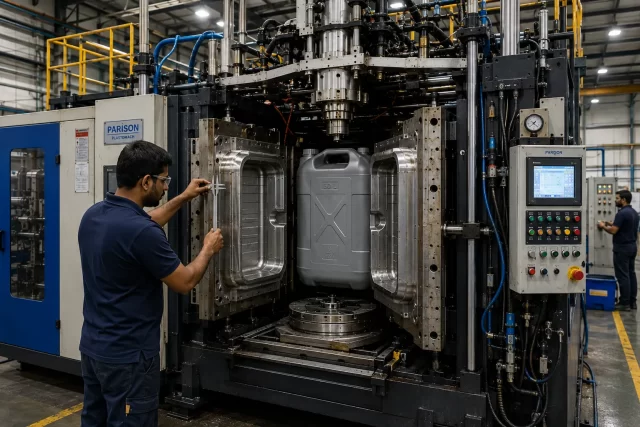
Machine capacity and production output are not the same thing. Container height, diameter, wall thickness, neck design, resin grade, mould configuration, extrusion output and cooling requirements can all affect the achievable cycle time and product quality.
The same issue appears during product development. A design team may approve a new container shape before production engineering checks whether the existing equipment can accommodate the mould comfortably.
That can lead to an avoidable chain of events: revised tooling, delayed trials, additional setup work and a later machine purchase.
For instance, a plant may approve a new 70-litre container and order the mould before checking the available clamping and machine space. When the mould arrives at the factory, the team discovers the existing machine cannot accommodate it without compromising access or setup. The team has already invested in the mould.
A better procurement process brings the machine supplier into the conversation while the product is still being evaluated. The supplier can then assess the container drawing, mould envelope, and process requirements before the business commits to tooling.
Checking the machine and mould envelope before ordering tooling can prevent avoidable redesigns, trial delays, and additional tooling costs.
Comparing Capacity On The Factory Floor
A simple production model can reveal whether upgrading capacity is justified. Instead of asking which machine is bigger, calculate how the proposed machine would change the working week.
For example, imagine a plant running three products. Product A provides most of the current revenue, Product B is growing steadily, and Product C is a new larger container that a customer wants to introduce next quarter.
The comparison might look like this:
Floor”:
| Production factor | Smaller model | 100-litre class | Larger class |
| Small container range | Usually well suited | May be underused | Often excessive |
| Medium-to-large products | Can become restrictive | Worth detailed evaluation | Strong capability |
| Larger mould requirements | More limited | Depends on configuration | Wider potential range |
| Factory footprint | Lower | Moderate to higher | Higher |
| Capital commitment | Lower | Moderate to higher | Higher |
| Future product flexibility | More limited | Balanced | High |
| Best fit | Stable smaller products | Expanding product range | Established large-format demand |
These categories are not performance guarantees. Actual output, cycle time and suitability depend on the machine configuration, mould, material and product design. 100 Litre Blow Moulding Machines should therefore be evaluated against the expected production workload rather than capacity alone.
The more useful figure is how many productive hours the machine is expected to run against confirmed demand. If it serves only one occasional order, the investment may be hard to justify; if it supports several regular products, the capacity has a stronger commercial case.
Bigger Containers Change Material Economics
Larger capacity should not be confused with automatic material efficiency. A manufacturer producing 50-litre HDPE containers may find during quality checks that the average product weight is consistently above the approved target. This can increase material consumption and production costs, making accurate weight control an important part of machine and process evaluation.
With 100 Litre Blow Moulding Machines, material efficiency depends on tooling, parison control, process settings and the ability to maintain the target product weight consistently.
Production teams should track material consumed per saleable container, startup scrap, rejected products and variation in product weight. These measurements can reveal whether process improvements are actually reducing resin consumption.
Energy use should also be compared. If a larger machine is used predominantly for smaller products, procurement teams should compare its actual utilisation and utility requirements with those of a smaller suitable model.
These measures connect machine selection with measurable resource use. Lower product-weight variation, fewer rejected containers and appropriate machine utilisation can reduce resin consumption, waste and associated operating costs.
When 200 And 500 Litres Become Justified
There is a point where a 100-litre class machine may no longer provide enough production flexibility.
A manufacturer receiving regular orders for large industrial containers may begin evaluating 200 litre blow moulding machines because the product itself requires larger mould dimensions and greater processing capability.
At 200 litres and above, the decision increasingly depends on the commercial workload behind the machine. The plant must have enough large-format orders to keep the equipment productive while supporting the additional tooling, floor space, utilities and maintenance requirements. Companies comparing 500 litre blow moulding machines manufacturers should already have a clear commercial reason for operating at that scale.
Consider a plant that receives one enquiry for a 500-litre tank but has no confirmed repeat demand. Buying equipment immediately could leave a high-value asset underutilised. Another manufacturer with recurring orders across several large-container products may have a completely different business case.
Larger capacity is easier to justify when confirmed orders and realistic forecasts provide enough production hours to keep the equipment meaningfully occupied.
Safety Belongs In Machine Procurement
Consider machine safety before installation, particularly when moving into a larger machine class with more substantial moving, heated, and pressurized components.
When evaluating 100 litre blow moulding machines, procurement and engineering teams should review safeguarding, emergency-stop arrangements, operator access and maintenance access alongside production requirements.
For installations in India, buyers should verify the applicable machinery, electrical safety and environmental requirements with the relevant authorities and qualified technical professionals before commissioning. The Occupational Safety, Health and Working Conditions Code, 2020 provides the central framework for occupational safety and working conditions.
The supplier should clearly explain the machine’s safety features, installation requirements, and commissioning responsibilities. The factory layout should also leave sufficient space for routine operation, inspection, mould changes, and maintenance.
The Right Capacity Depends On Demand
The better choice between smaller equipment and 100 litre blow moulding machines depends on product dimensions, mould requirements, confirmed order volumes, expected machine hours, material consumption, energy demand and factory infrastructure. A smaller machine can be the financially sound option for a stable product range, while a 100-litre class machine can make sense when larger products are becoming a regular part of production.
Contact IFC blow moulding with your container dimensions, target weight, material, mould details, and expected production volume. The IFC team can then help you assess which machine configuration best fits your product range and production requirements.
Frequently Asked Questions
Can a 100-litre machine replace smaller machines?
Not necessarily. Replacement depends on the product range, mould compatibility, output requirements and utilisation. 100 litre blow moulding machines may consolidate certain production needs, but keeping smaller equipment can be sensible when compact products represent most of the workload.
Does higher capacity mean higher production output?
No. Capacity refers to the product size the machine is designed to handle, not a guaranteed production rate. Actual output depends on cycle time, extrusion rate, mould design, material, cooling and machine configuration.
How does mould size affect machine selection?
Mould dimensions influence whether the machine can accommodate the tooling safely and correctly. For 100 litre blow moulding machines, clamping space, mould height, width, product geometry and handling arrangements should therefore be checked before purchasing equipment for a new container.
Can a larger machine reduce material waste?
It can support efficient production when correctly configured, but machine size alone does not reduce waste. Product design, tooling, process control, target weight, operator settings, and quality checks all influence material consumption and scrap.
When should a manufacturer consider 200-litre equipment?
A manufacturer should consider larger equipment when regular products require greater container volume, larger mould dimensions, or higher processing capability. Confirmed demand and expected machine utilisation should support the investment before moving beyond 100 litre blow moulding machines.
What should be compared besides machine price?
Compare machine configuration, mould compatibility, utility requirements, expected output, material efficiency, maintenance access and technical support. An HDPE blow moulding machine manufacturer should also demonstrate suitable commissioning, training and after-sales support before purchase.
