
The decision becomes clearer when you look at what happens inside a real plant. A machine may spend part of the day waiting for a mold change, an operator may need to correct a process setting, or a customer may suddenly reduce an order from 10,000 units to 4,000. Rated capacity alone does not solve any of these problems.
For plant owners and procurement teams in blow moulding India, understanding how to assess whether a machine produces a saleable product reliably can build confidence in your procurement decisions, ensuring costs align with actual needs.
Where 30-Litre Capacity Fits Best
30 litre blow moulding machines are worth considering when a manufacturer’s typical product range sits within a moderate capacity band, and production does not justify a substantially larger installation.
Imagine a packaging supplier serving several regional businesses. One customer needs a short run of chemical containers, another orders a different industrial container, while a third wants samples before committing to a larger order. The plant needs flexibility more than maximum output.
A smaller-capacity machine can make this type of production easier to manage. The manufacturer can schedule shorter runs without automatically dedicating a large machine to every order.
However, procurement should never select capacity based on the product name alone. Procurement should check the actual product dimensions, weight, mould size, neck configuration, material, and required cycle time.
For a 30-litre machine, procurement should also examine the extrusion output, die-head arrangement, clamping system, parison control, cooling provision and expected cycle time. Focusing on these specific specifications helps ensure the machine can consistently meet product quality and production rate requirements.
What Small Batches Reveal On The Factory Floor
30 litre blow moulding machines therefore need to be judged by how consistently they handle setup, adjustment and repeated product changes, as these factors directly impact production efficiency and schedule adherence.
Consider a plant producing three container designs during one shift. If each changeover takes longer than planned, the production schedule begins slipping before the first quality issue appears. Add a few rejected containers during setup, and the usable output falls further.
For a production engineer, this is a practical reason to examine controls, accessibility and setup procedures before procurement, helping you feel supported and confident in your ability to manage the machine efficiently.
What Procurement Teams Should Check First
A machine quotation tells you what you are buying; it does not always tell you how easily that machine will fit into your production process. When comparing plastic blow moulding machine manufacturers in India, procurement teams should look beyond the initial quotation and examine how the supplier approaches the complete production requirement.
A useful supplier discussion should begin with the product rather than a standard machine model, especially when evaluating an HDPE blow moulding machine manufacturer for a specific application. This gives the manufacturer a better basis for recommending the machine configuration.
Ask for clarity on:
- Expected production output under the proposed operating conditions.
- Mould compatibility and maximum practical product dimensions.
- Utility requirements, including electrical and compressed-air needs.
- Recommended maintenance intervals and critical wear components.
- Availability of replacement parts and technical assistance.
- Installation, commissioning and operator training.
- Expected changeover time between the planned moulds.
These details can reveal differences between suppliers that are invisible when you compare quotations based only on price.
For an Indian plant, local technical support can also reduce the risk of prolonged downtime when a component needs inspection, replacement or adjustment.
Controlling Parison Quality During Production
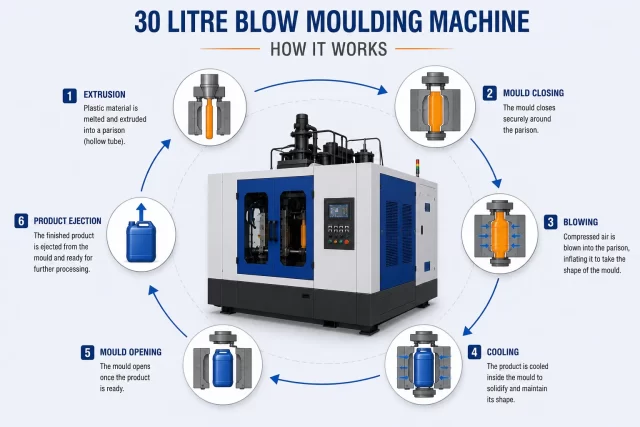
In extrusion blow moulding, the parison must distribute material correctly before the mould closes. Poor distribution can leave some areas unnecessarily thick while weakening others.
That makes process stability an important consideration when evaluating 30 litre blow moulding machines for containers with different shapes, wall sections or neck designs.
Take a container with a broad body and a relatively narrow opening. If material distribution is poorly controlled, the finished container may have unnecessary thickness in one area and insufficient material in another. The product might then fail dimensional or performance checks even though the machine completed the cycle.
This creates a familiar manufacturing problem: more resin goes into the batch, but not all of it becomes saleable product.
Procurement teams should therefore ask extrusion blow moulding machine manufacturers how the proposed configuration handles the intended product geometry and material. The answer should be specific to the application, not a general claim about machine capability.
Calculate The Cost Of Machine Downtime
The purchase price is easy to compare, downtime is not. If a critical component fails and production stops for two days, the cost includes lost output, delayed deliveries, labour that cannot run the planned batch and potentially higher freight or overtime costs later.
Capacity should therefore be compared against the products the plant actually expects to run. The table below gives a practical starting point for comparing different machine classes.
|
Factor |
30-litre class | 100-litre class | 200-litre class | 500-litre class |
|
Smaller production runs |
Strong fit | Depends on demand | May be more capacity than required | Usually excessive |
|
Medium industrial containers |
Product-dependent | Stronger fit | Strong fit |
Application-dependent |
|
Very large containers |
Limited | Limited to suitable designs | More suitable |
Designed for large applications |
|
Floor-space demand |
Generally lower | Moderate | Higher |
Substantially higher |
|
Capital commitment |
Generally lower | Higher | Higher |
Significantly higher |
| Best procurement question |
Is capacity sufficient? |
Can demand justify it? |
Can utilisation stay high? |
Does the product require it? |
When Bigger Machines Become A Burden
“Buy bigger now and grow into it” sounds sensible until the machine spends most of the week waiting for orders. Future demand, however, is not guaranteed simply because the plant has invested in additional capacity.
For a small manufacturer, 30 litre blow moulding machines can sometimes provide a better balance between present requirements and expansion plans.
Suppose a plant is currently operating at 50% utilisation on a smaller machine. Buying substantially larger equipment does not necessarily double useful output. If customer demand remains irregular, the plant may have a more expensive asset sitting idle between orders.
There are also indirect costs. Larger equipment may require more floor space, higher utility capacity, additional handling arrangements and different maintenance resources.
A sensible expansion plan can involve increasing machine capacity after demand becomes predictable rather than paying for a larger blow moulding machine in India years in advance.
Reducing Material Waste In Production
Material efficiency is especially important when resin prices make up a significant part of product cost. A rejected container does not just represent lost material; it also carries the electricity, compressed air, labour and machine time used to produce it.
30 litre blow moulding machines can support a more controlled production model when the machine is correctly matched to the product and operated within its intended conditions.
A plant should monitor:
- Resin consumed against saleable output.
- Reject percentage by product and production batch.
- Energy consumption during normal production.
- Time lost during changeovers and stoppages.
- Rework and trimming generated after moulding.
Tracking these figures helps the production team identify which products, moulds or process stages are creating avoidable losses. If one mould consistently produces more rejects than another, the production team can investigate the cause instead of simply accepting higher material consumption.
Manufacturers should also consider applicable environmental requirements for plastic waste management and resource use, alongside relevant local regulations and the plant’s environmental management procedures.
That is where sustainability becomes an operational discipline rather than a marketing statement.
Maintenance Can Decide Your Real Output
A machine can have an excellent production specification and still become a poor investment if routine maintenance is difficult to manage.
When evaluating 30 litre blow moulding machines, ask what happens when a sensor fails, a pneumatic component wears or a moving assembly requires attention. The answer can reveal more about practical machine ownership than the purchase price.
For example, a production line may stop at 10 AM because a relatively inexpensive component needs replacement. If the part is unavailable locally and the supplier needs several days to arrange it, the lost production can quickly outweigh the original component cost.
Preventive maintenance helps reduce this risk. Operators should know which areas require routine inspection, while maintenance teams should understand wear indicators and recommended service intervals.
When 100 And 200 Litres Make Sense
Manufacturers comparing 100 litre blow moulding machines or 200 litre blow moulding machines should ask whether their product range actually requires the additional capacity.
A company supplying larger industrial containers, for instance, may quickly outgrow smaller equipment. In that case, buying a higher-capacity machine from the start can avoid a second capital investment.
The same comparison is useful when evaluating options from 500 litre blow moulding machines manufacturers for larger industrial applications. Equipment in this class serves different production requirements and should be evaluated around large-product geometry, handling arrangements, cycle requirements, and plant infrastructure.
A useful procurement forecast should therefore include current orders, realistic growth, planned products and expected machine utilisation. If the forecast does not support the investment, smaller equipment may be the more disciplined decision.
Safety Belongs In The Procurement Stage
Safety should be considered during machine specification, rather than after installation, when changes to guarding, access points or control arrangements may become more difficult and costly.
For procurement teams, the practical checks include operator access, maintenance access, guarding around moving or heated components, emergency functions and the ability to isolate hazardous energy during servicing. These requirements should be assessed against the machine configuration and the plant’s own safety procedures.
Before purchasing, manufacturers should request the supplier’s technical and compliance documentation for the specific machine model and configuration.
Conclusion
30 litre blow moulding machines can be a practical choice when a plant runs moderate batches, several product designs or a developing order book. Assess suitability based on actual product dimensions, mould requirements, cycle time, material consumption, machine utilisation, maintenance needs, and future demand. For a small manufacturer, productive utilisation can matter just as much as maximum machine capacity.
Contact IFC blow moulding with your product dimensions, material, mould details and expected production volume to discuss a machine configuration suited to your production requirements.
Frequently Asked Questions
1. What products can a 30-litre blow moulding machine make?
30 litre blow moulding machines can produce suitable hollow products such as containers, cans, tanks and industrial packaging. The actual range depends on the product’s dimensions, material, mould design, die-head configuration, and machine capability.
2. How do I know if 30-litre capacity is enough?
Compare the product’s dimensions, weight, mould requirements, required output, and planned production hours against the machine’s practical operating range. Do not select capacity based on the litre rating alone.
3. Can a 30-litre machine handle different moulds?
30 litre blow moulding machines can support multiple product designs when mould dimensions, clamping arrangement, die-head configuration, and machine specifications are compatible. Consider the changeover time when using several moulds in the same shift.
4. What causes defects in blow-moulded products?
Common causes include unstable parison distribution, incorrect processing conditions, cooling problems, mould issues, and material variation. Consistent machine settings and proper process control can help reduce rejects and production losses.
5. Should I choose a 100-litre or 200-litre machine instead?
Choose higher capacity when your products, order volumes, or planned expansion genuinely require it. A larger machine can become an unnecessary capital and utility expense when the plant cannot keep it productively occupied.
6. What should I check before buying a 30-litre machine?
Before buying 30 litre blow moulding machines, review extrusion output, parison control, mould compatibility, cooling, cycle time, material suitability, utilities, maintenance access, spare-parts availability, and technical support. These factors influence actual production performance.
