
Today, manufacturers are under increasing pressure to cut costs while maintaining high production and quality. The Blow Moulding Machine in India gives an organized answer in this situation. It lets producers manage exactly how much material they use, keeps production cycles steady, and enables large-scale manufacturing without sacrificing reliability.
What makes blow moulding India particularly relevant today is its ability to connect engineering precision with real business outcomes. It does not just improve production; it gives better control over how production runs.
Packaging As A Variable Cost Engine
Packaging costs often receive less attention than raw materials or labour, yet they can significantly affect margins in high-volume production. Blow Moulding India helps manufacturers control these expenses through smarter material use and more efficient packaging design. Even a small reduction in plastic used per unit can add up to substantial yearly savings, especially for manufacturers producing millions of bottles every month.
Beyond raw material, packaging design also affects logistics. Optimized shapes improve stacking efficiency, reduce storage space, and minimize transportation costs. Poorly designed packaging, on the other hand, increases handling risks and reduces supply chain efficiency. The blow moulding India enables continuous refinement of these parameters. Manufacturers can test different configurations, measure outcomes, and standardize the most efficient solution, helping them feel confident in managing costs effectively.
Parison Control And Wall Thickness Engineering
A key technical advantage of blow moulding machines is their ability to control parison formation and wall thickness with precision. As a result, packaging becomes more than a basic container and turns into a properly engineered product.
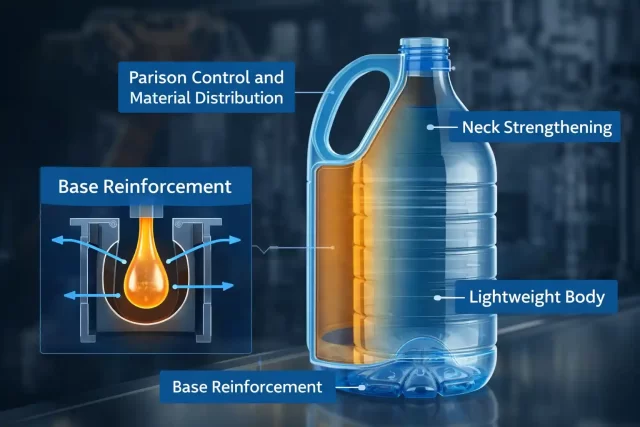
Traditional methods often spread material evenly, which can waste plastic in areas that do not need extra strength. Blow moulding works differently. It allows manufacturers to place material where it matters most. Critical zones such as the base, shoulders, and neck can be reinforced, while other areas stay lightweight.
A good example is a liquid detergent bottle. The handle, neck, and bottom section deal with more stress during lifting, pouring, and transport. Blow moulding adds extra strength to these areas while keeping the main body lighter and easier to carry.
This smart material distribution improves durability without adding unnecessary weight. It also helps reduce the risk of cracks, leakage, or damage during everyday use and transport. Blow Moulding India keeps this level of precision consistent across production cycles. Such consistency is essential for industries where even small variations can lead to performance issues or regulatory concerns.
Blow Moulding Machine in India: Advancements
The blow moulding machine has incorporated key advancements across industries such as FMCG, pharmaceuticals, and automotive, demonstrating that adopting these innovations can significantly boost production efficiency and product quality.
Key trends shaping the industry:
- Closed-loop control systems that continuously adjust process parameters
- Multi-layer extrusion enabling barrier protection and product safety
- Accumulator head systems for producing large and complex containers
- Real-time monitoring interfaces for tracking performance and output
These innovations reduce reliance on manual intervention and improve process stability. They also help manufacturers maintain consistent production with minimal defects and downtime.
The blow moulding India has evolved into a fully integrated production system that seamlessly combines mechanical precision with digital control, providing manufacturers with a competitive edge and easier integration with existing setups to meet modern demands.
Cycle Time Optimization And Throughput Logic
Cycle time optimization is one of the most critical aspects of manufacturing efficiency. In a blow moulding machine, each stage of the production cycle, heating, forming, and cooling, is carefully controlled to ensure consistency.
If any of these stages are misaligned, it can lead to defects or reduced output. For instance, uneven heating can create weak spots, while inefficient cooling can unnecessarily extend cycle time. Blow moulding systems address these challenges by maintaining stable and synchronized process conditions.
With this level of stability, manufacturers can plan output more accurately, which is essential for meeting production targets and delivery schedules. It also reduces variability, making it easier to manage inventory and plan operations. The blow moulding India ensures efficiency without compromising product quality, creating a reliable, scalable production process.
Operational Gains Beyond Basic Efficiency
While increased production speed is an obvious benefit, blow moulding delivers operational improvements that extend beyond simple efficiency metrics.
Major advantages include:
- Consistent production cycles that reduce variability
- Lower rejection rates due to controlled processing conditions
- Reduced dependency on manual adjustments during production
- Improved energy utilization through optimized heating systems
- Faster product changeovers, supporting flexible manufacturing
These improvements contribute to a more stable production environment, where processes are predictable and easier to manage. For manufacturers, this stability is particularly valuable in large-scale operations where small inconsistencies can lead to significant losses.
Real-World Industry Constraints And Adaptation
One of the strongest advantages of blow moulding India is its ability to adapt to different industry requirements without requiring entirely new systems, giving decision-makers confidence in its flexibility and long-term viability.
In pharmaceutical manufacturing, strict hygiene standards and dimensional accuracy are critical. Blow moulding supports this through controlled production environments and consistent output. In FMCG, the focus shifts to high-speed production and cost efficiency, where maintaining uniformity across large volumes is essential.
Industrial applications, such as automotive or chemical storage, introduce additional challenges. Packaging must withstand pressure, temperature fluctuations, and exposure to harsh environments. Blow moulding addresses these requirements through adjustable parameters and structural control.
The blow moulding machine allows manufacturers to operate across these varied conditions without compromising performance, making it a highly versatile solution.
Dimensional Stability And Product Integrity
Dimensional stability is important to ensure that packaging maintains its shape and performs well after it is made. Blow moulding India does this by controlling cooling and ensuring even expansion.
Without sufficient control, products may change shape or size over time, making them hard to stack, move, and use. Blow molding methods mitigate these hazards by maintaining consistent process conditions throughout production.
The blow moulding keeps precision consistent even during high-volume production, reducing failures and improving overall product quality. Manufacturers using blow moulding India must follow applicable quality, safety, and material compliance standards to ensure product reliability and meet industry regulations.
Traditional Systems Versus Engineered Moulding
The advantages of blow moulding become more apparent when compared with conventional manufacturing methods:
|
Parameter |
Conventional Systems |
Blow Moulding Systems |
|
Wall Thickness Control |
Limited | Programmable |
| Process Stability | Operator-dependent |
System-controlled |
|
Output Predictability |
Variable | Consistent |
| Material Efficiency |
Approximate |
Optimised |
| Design Adaptability | Restricted |
Highly flexible |
| Defect Prevention | Reactive |
Preventive |
The comparison highlights the shift towards precision-driven manufacturing.
Sustainability Through Engineering Precision
Blow moulding India supports sustainability mainly through process efficiency rather than external adjustments. By optimizing material usage, manufacturers reduce plastic consumption at the source.
Energy-efficient systems further reduce operational impact, while the use of recycled materials supports environmentally responsible production practices. These improvements extend beyond the factory, as lightweight packaging reduces transportation load and associated emissions.
The blow moulding machine integrates sustainability into the production process, making it a practical solution for long-term environmental goals.
Design Integration With Functional Performance
Packaging design must balance aesthetics with functionality. Blow moulding India allows manufacturers to integrate both aspects directly into production.
Design features such as ergonomic shapes, reinforced structures, and stackable forms improve usability and logistics efficiency. These features are developed alongside production parameters, ensuring that they are practical and achievable. The blow moulding machine maintains these designs, aligning design intent with production output.
Data-Driven Production And Predictive Control
The role of data in manufacturing continues to grow, and blow moulding India is adapting to this shift. Modern machines use sensors to monitor key parameters in real time. At scale, data allows operators to maintain optimal conditions and quickly address deviations. Predictive maintenance systems further enhance reliability by identifying potential issues before they lead to downtime.
The blow moulding machine is evolving into a smart production system that supports continuous improvement and operational efficiency.
Scalable Manufacturing Without System Disruption
When production is scaled up, it often becomes more complex. But blow moulding India makes it easier with modular, flexible solutions. Instead of rebuilding whole systems, manufacturers can increase capacity by upgrading parts or adding modules.
This approach allows manufacturers to scale gradually while maintaining stability and control. The blow moulding enables this flexibility, so firms can grow without having to stop what they are already doing.
Conclusion: Engineering Packaging As A Business Advantage
Packaging has become a critical part of manufacturing strategy, and blow moulding India provides the precision and control needed to manage it effectively.
From material optimization to production efficiency, it offers a comprehensive solution for modern manufacturing challenges. The blow moulding enables businesses to scale operations while maintaining quality and consistency. If you are looking to enhance your packaging systems, visit IFC Blow Moulding today or contact their team to upgrade your production with advanced blow moulding solutions.
Frequently Asked Questions (FAQ)
- What is blow moulding India, and how does it work?
Blow moulding is a process used to create hollow plastic products by expanding heated material inside a mould. A moulding machine in India controls this process to ensure consistent shape, strength, and production efficiency.
- Why is the Blow Moulding Machine in India preferred for packaging?
Manufacturers in India prefer Blow Moulding Machines because they produce lightweight, durable, and consistent packaging at scale. Blow moulding India helps factories maintain high production speeds, improve consistency, and reduce material waste.
- How does blow moulding machine in India help reduce manufacturing costs?
Blow moulding India reduces costs by optimizing material usage and improving cycle efficiency. With a blow moulding, manufacturers can minimize waste, reduce rejection rates, and increase output without increasing operational expenses.
- Is the blow moulding machine in India suitable for large-scale production?
Yes, a Blow Moulding Machine in India is designed for high-volume manufacturing. blow moulding India ensures stable production cycles, consistent quality, and minimal downtime, making it ideal for industries that require continuous, scalable output.
