
Consistent product quality is not simply about appearance. It directly affects durability, storage efficiency, transportation safety, and compliance with industry requirements. Understanding how modern 200-litre blow moulding technology supports these outcomes can help manufacturers make more informed decisions when investing in production equipment.
Why Product Consistency Drives Success
Large-capacity plastic containers are used in industries where reliability is essential. Even small differences in dimensions, wall thickness, or structural strength can create challenges during transportation, storage, and handling.
For example, a chemical manufacturer in Gujarat or a lubricant producer in Maharashtra may ship thousands of 200-litre HDPE drums every month across India and international markets. Even slight variations in drum dimensions can create stacking issues, increase transportation risks, and lead to rejected consignments. Consistent production helps businesses avoid these costly disruptions while maintaining customer confidence.
Manufacturers supplying industrial containers for hazardous materials should ensure that packaging systems comply with applicable Indian transportation and hazardous goods packaging requirements, including UN-certified packaging standards where required for the safe transport of dangerous goods.
Leading 200 litre blow moulding machines manufacturers in India focus on technologies that minimise variation throughout the manufacturing process, helping businesses maintain consistent quality standards across every production cycle.
Some of the key advantages include:
- Uniform container dimensions for easier stacking and transportation.
- Reduced rejection rates during quality inspections.
- Better resistance to impact and external pressure.
- Consistent material distribution throughout the container.
- Improved customer confidence through reliable product performance.
200 Litre Blow Moulding Machines Manufacturers
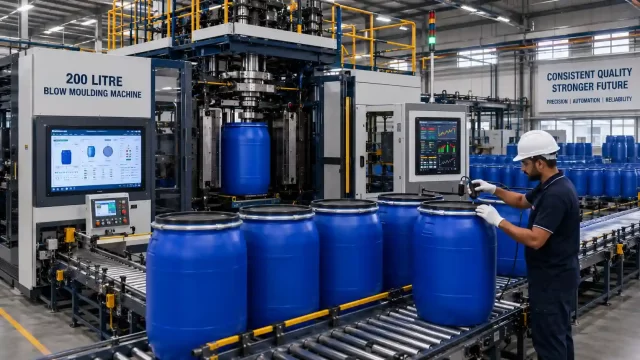
The quality of a finished container begins with the machine itself. Experienced moulding machines manufacturers integrate advanced automation systems that regulate temperature, extrusion speed, air pressure, mould movement, and cooling cycles to support consistent production performance.
Real-time monitoring technology further enhances quality control by identifying variations before they develop into larger issues.
This level of precision is particularly important for manufacturers supplying containers to the pharmaceutical, agrochemical, and speciality chemical industries, where strict industry standards and regulations demand consistent quality, weight, and strength to ensure compliance and operational efficiency.
For manufacturers producing containers for chemicals, lubricants, food products, and industrial applications, this precision helps ensure every container meets demanding performance requirements.
How Extrusion Control Improves Quality
The extrusion stage plays a vital role in determining the overall quality of a blow-moulded product. Variations during extrusion can affect wall thickness, weight distribution, and structural integrity.
This is why leading extrusion blow moulding machine manufacturers invest heavily in technologies that provide greater control over material flow and processing conditions. The following table highlights how key production controls contribute to product consistency.
|
Production Factor |
Impact on Product Quality | Manufacturing Benefit |
| Melt Temperature Control | Uniform material flow |
Consistent wall thickness |
|
Parison Programming |
Accurate material placement | Improved strength |
| Pressure Regulation | Stable container formation |
Fewer defects |
|
Cooling Management |
Better dimensional accuracy | Enhanced durability |
| Automation Systems | Reduced process variation |
Higher consistency |
Effective extrusion control also helps prevent common manufacturing defects that can affect product performance. Uneven wall thickness may weaken container strength, while excess flash can increase material consumption. Weight variation often leads to quality rejections, and dimensional inconsistencies can create storage and transportation challenges. Advanced extrusion systems help minimize these issues before they affect production output.
These controls allow 200 litre blow moulding machines manufacturers to produce containers with predictable performance characteristics while reducing unnecessary material waste. Improved process stability also helps maintain production efficiency across extended manufacturing schedules.
Plastic Blow Moulding Machine Manufacturers in India
India’s manufacturing sector continues to expand, creating greater demand for high-quality plastic packaging solutions. Industries increasingly require containers that meet strict quality standards while supporting large-scale production requirements.
To address these expectations, leading plastic blow moulding machine manufacturers in India are adopting smart technologies that inspire confidence in their ability to deliver reliable, high-quality solutions.
Several innovations contribute to better product consistency:
- Automated monitoring of critical production parameters.
- Advanced control systems that maintain stable operating conditions.
- Precision mould designs that improve dimensional accuracy.
- Efficient cooling systems that reduce product variation.
- Data-driven process management that supports quality assurance.
This capability has become increasingly valuable as Indian manufacturers expand into export markets. Buyers across international industries expect packaging products to meet consistent quality standards regardless of production volume. Smart monitoring technologies help manufacturers achieve this level of repeatability while maintaining competitive production costs.
Many 200 litre blow moulding machines manufacturers in India continue investing in automation and process monitoring technologies. These advancements help manufacturers identify potential issues early and maintain greater control throughout the production cycle. As a result, businesses can improve product reliability while supporting higher production volumes.
Why HDPE Processing Matters
High-density polyethylene remains one of the most widely used materials for industrial containers due to its durability, chemical resistance, and long service life. However, achieving consistent quality with HDPE requires careful control throughout the manufacturing process.
A trusted HDPE blow moulding machine manufacturer designs machinery specifically to handle HDPE’s unique processing characteristics. Stable operating conditions are essential for maintaining product strength and dimensional accuracy.
Modern machine designs address these challenges through precise temperature management, accurate material distribution, controlled cooling rates, and reliable mould performance during repeated production cycles. Together, these capabilities help manufacturers create durable containers with consistent quality characteristics.
This level of control is particularly valuable for industries where container performance directly affects product safety, storage efficiency, and transportation reliability. This is why 200 litre blow moulding machines manufacturers in India place significant emphasis on HDPE processing capabilities.
Indian industrial containers are often exposed to demanding operating conditions. A drum manufactured in western India may travel hundreds of kilometres through high summer temperatures before reaching warehouses, factories, or export facilities. Consistent HDPE processing ensures the container maintains its strength, shape, and performance throughout these challenging logistics environments.
Smart Engineering Behind Precision
Product consistency depends on more than advanced machinery. It requires intelligent engineering that combines automation, process optimisation, and production stability.
Many leading 200 litre blow moulding machines manufacturers in India now incorporate Industry 4.0 technologies into their equipment. These systems use sensors and digital monitoring tools to collect operational data throughout production.
By analysing this information in real time, manufacturers can identify emerging trends before they affect product quality. This proactive approach supports preventive maintenance, reduces downtime, and improves long-term manufacturing performance.
Modern engineering improvements also contribute to greater production repeatability, reduced operational variation, improved energy efficiency, and more stable manufacturing conditions. These benefits help businesses maintain consistent quality standards while improving productivity.
Predictive monitoring is particularly valuable in high-volume facilities producing thousands of containers each day. Identifying minor process deviations early helps manufacturers avoid large batches of defective products, reducing both material waste and production downtime.
Blow Moulding India Growth Trends
The growth of Blow Moulding India is being driven by expanding demand from the chemical processing, agriculture, lubricant, food ingredients, pharmaceutical, and industrial manufacturing sectors. Many of these industries require large-capacity containers that can safely store and transport products under demanding conditions.
Export-oriented manufacturers face additional challenges because their packaging products often must comply with customer specifications across multiple countries. Consistent drum dimensions, weight accuracy, and structural performance help reduce the risk of shipment rejections while supporting stronger relationships with international buyers.
Government initiatives supporting domestic manufacturing and exports have further increased investment in advanced production technologies. As Indian manufacturers continue supplying international markets, demand is growing for containers that consistently meet global quality expectations. This trend is encouraging businesses to adopt modern blow moulding systems that combine productivity with precision. To meet this demand, 200 litre blow moulding machines manufacturers in India are developing solutions that balance productivity with quality.
Growth across manufacturing hubs in Gujarat, Maharashtra, Tamil Nadu, and other industrial regions is also increasing demand for high-output packaging equipment. Manufacturers operating in these markets require consistent quality to meet both domestic and export expectations.
Comparing Different Capacity Machines
Manufacturers often evaluate different machine capacities before selecting equipment that aligns with their production requirements. While 100 litre blow moulding machines are suitable for medium-capacity applications and 500 litre blow moulding machines support larger industrial requirements, 200-litre systems offer a highly versatile solution.
The 200-litre category balances production efficiency, operational flexibility, and market demand. This makes it a popular choice for businesses that manufacture industrial drums, storage containers, and chemical packaging. Many 200 litre blow moulding machines manufacturers in India consider this capacity ideal for industrial packaging applications.
How to Choose the Best Blow Moulding Machine in India
Selecting the best blow moulding machine in India requires more than comparing production speeds or machine specifications. Businesses should focus on factors that directly influence product quality and operational reliability.
A high-quality machine combines precise extrusion control, advanced automation features, dependable mould performance, consistent production repeatability, and strong after-sales support. Together, these capabilities help manufacturers achieve better quality outcomes while reducing operational risks.
Manufacturers should also evaluate how effectively a machine prevents common production issues such as warping, inconsistent weight distribution, uneven wall thickness, and excessive material waste. Equipment capable of maintaining stable performance under continuous production conditions typically delivers stronger long-term value. Experienced 200 litre blow moulding machines manufacturers in India often differentiate themselves through engineering precision and automation.
Long-term success often depends on choosing equipment that maintains stable performance over years of production. Machines designed with quality-focused engineering provide manufacturers with greater confidence, improved efficiency, and stronger returns on investment.
Conclusion
In industries where a single defective drum can result in product loss, shipment delays, or customer complaints, consistency becomes a critical business requirement rather than a production goal. Advanced 200 litre blow moulding machines manufacturers in India support this objective through intelligent automation, precise extrusion control, HDPE processing expertise, and smart engineering technologies. By reducing defects, minimising material waste, preventing production inconsistencies, and improving container reliability, these machines help manufacturers meet increasingly demanding market expectations.
If you are looking to improve production consistency and invest in advanced blow moulding technology, Contact IFC Blow Moulding today to explore innovative machinery solutions designed for long-term manufacturing success.
Frequently Asked Questions
Why should businesses choose 200 litre blow moulding machines manufacturers in India?
Businesses often choose these manufacturers because they offer advanced technology, local technical support, cost-effective production solutions, and machinery designed for chemical, lubricant, pharmaceutical, and industrial packaging applications.
Why is wall thickness important in blow-moulded containers?
Wall thickness directly affects durability, impact resistance, and load-bearing capacity. Consistent wall distribution helps containers maintain structural integrity during transportation, storage, and handling while reducing the risk of leaks or product failure.
What industries benefit most from equipment supplied by 200 litre blow moulding machines manufacturers in India?
Industries such as chemicals, agrochemicals, lubricants, food processing, pharmaceuticals, and industrial manufacturing benefit from equipment supplied by 200 litre blow moulding machines manufacturers in India due to its ability to deliver consistent container quality and production efficiency.
How does automation support quality control in blow moulding?
Automation continuously monitors production variables such as temperature, pressure, extrusion flow, and cooling performance. Real-time adjustments help prevent variations, reduce defects, and maintain consistent quality throughout the manufacturing process.
How do 200 litre blow moulding machines manufacturers in India help improve production efficiency?
Manufacturers improve production efficiency by integrating automation, precision extrusion control, intelligent monitoring systems, and reliable moulding technologies that reduce defects, minimise material waste, and support consistent output across large production runs.
