
Machine price and maximum output alone tell a procurement team very little about whether the best blow moulding machine in India will perform economically on the factory floor. For a manufacturing business, the more important question is how consistently the equipment produces the required product and what it costs to keep that production running.
Plant owners, procurement managers and production engineers also need to consider mould compatibility, polymer selection, power requirements, maintenance access and technical support before making a major capital investment.
Begin With the Product Specification
Choose the machine around the product you intend to manufacture. Starting with available models can create compromises when product requirements change.
The best blow moulding machine in India for a small packaging container may be unsuitable for a large industrial drum. Product weight, dimensions, wall thickness, neck design and material all affect the machine configuration.
For a plant producing 5-litre HDPE containers, establish the target product weight, hourly output and mould dimensions before requesting machine recommendations.
Consider future mould sizes and product variations. Confirm the machine can accommodate likely product expansion and design changes to avoid additional capital expenditure and keep the investment cost-effective over time. Before requesting quotations, establish:
|
Production factor |
What to establish |
| Material | Polymer grade and processing requirements |
| Product | Weight, dimensions and wall requirements |
| Output | Required units per hour and operating hours |
| Mould | Dimensions, cavities and future requirements |
| Utilities | Power, compressed air, cooling and floor space |
With these details defined, suppliers can quote against the same production requirement instead of presenting unrelated machine configurations.
Watch the Machine Through a Full Run
A few successful samples do not prove that a machine is ready for production. Consistency during a sustained run is a better measure when assessing a machine for production.
During a supplier demonstration, run a product similar to what you plan to make in your factory and observe the best blow moulding machine in India after continuous operation, not just the first few cycles.
For plastic blow moulding machine manufacturers in India, application testing should be part of the discussion. The supplier should understand the product and material before recommending a particular machine configuration.
Check finished products for weight, dimensions, appearance and wall distribution. Frequent operator adjustments can indicate instability and affect output during a shift.
In extrusion blow moulding, parison control deserves particular attention. If material distribution changes during extrusion, some areas of the container may become thinner while others carry unnecessary material.
Keep Resin Consumption Under Control
Resin is a recurring production expense, so product weight deserves the same attention as machine speed. The machine should achieve the required product strength without routinely adding material to compensate for inconsistent processing.
Consider a manufacturer producing 10,000 containers daily. An extra 3 grams per container means 30 kilograms of additional resin consumption each day. Over a working year, that difference becomes substantial.
Material efficiency also affects sustainability because unnecessary resin means additional material, production energy and waste handling. Do not reduce product weight without checking strength, dimensions, and intended use. The finished container must still meet its required specifications.
When assessing a machine, discuss target product weight, parison programming, material recovery, expected rejection and compatibility with the polymer grades used in production.
Compare Power Use With Output
The electrical rating printed on a machine does not tell you what the equipment will consume during normal production. When comparing the best blow moulding machine in India for a production line, assess electricity costs alongside output, material use, and operating hours.
Request consumption figures under conditions close to your intended production. An installed-load figure alone will not show what the machine is likely to use during an actual shift. Two blow moulding machines in India may produce the same bottle at a similar rate but use different amounts of electricity, affecting production costs throughout their working life.
Energy efficiency not only reduces resource consumption but also aligns with procurement teams’ goals for sustainable, cost-effective operations, fostering responsible decision-making. Include electricity, resin waste, maintenance, consumables and downtime in the ownership calculation. A lower purchase price may lose its advantage if operating costs are higher.
Large Containers Need Different Planning
Large-format production introduces challenges that do not appear with small containers. For large products, machine capacity is only one part of the decision.
For 100 litre blow moulding machines, examine extrusion capacity, clamping performance, mould dimensions, cooling and mould handling.
At the 500-litre level, factory planning becomes equally important. 500 litre blow moulding machines can require considerable space for mould loading, product removal and material handling.
A plant may have enough floor space for the machine, yet its lifting equipment may not position the mould safely. Before ordering, confirm floor space, electrical supply, compressed air, cooling, access routes and material handling.
Calculate the Cost of a Breakdown
Maintenance becomes costly when a machine stops during a committed production schedule. When comparing blow moulding machine manufacturers, technical support and spare-parts availability can significantly affect ownership cost. These factors also matter when evaluating the best blow moulding machine in India, particularly for plants operating multiple shifts where a long repair delay can affect committed production.
Maintenance teams should know which components need routine inspection, servicing intervals and accessible assemblies.
Ask suppliers about commonly required spare parts and their availability. A small component can stop a production line if it is unavailable when needed. Trained operators can identify process changes early, while maintenance staff handle routine work correctly.
Discuss installation, commissioning, training, preventive maintenance and technical assistance before finalising the purchase order.
Buy Automation That Solves Problems
Automation can reduce operator intervention, maintain settings between shifts and identify process changes before they create large batches of rejects. When evaluating the best blow moulding machine in India, focus on controls that solve actual production problems.
A manufacturer comparing a PET bottle blowing machine manufacturer should assess technology according to its PET production requirements, bottle design, output target and operating model.
The same applies when evaluating an HDPE blow moulding machine manufacturer. The supplier should be able to explain how the proposed equipment handles the intended HDPE material, product weight and production rate. Repeatable settings can maintain production conditions between shifts and help identify changes before they create rejects.
Verify Compliance Before Installation
Check compliance while the machine is still being evaluated, not after delivery. Buyers should ask manufacturers for the applicable safety, technical and conformity documentation for the proposed equipment.
Before installation, confirm whether the proposed machinery falls under applicable BIS requirements, including Scheme-X certification provisions, and check any relevant Plastic Waste Management and EPR obligations for the business.
Establishing these requirements during procurement can prevent documentation gaps, installation delays and uncertainty when the equipment is commissioned.
Compare Suppliers on Technical Answers
When assessing extrusion blow moulding machine manufacturers, give each shortlisted supplier the same product weight, material, dimensions, mould information and production target. That gives the procurement team a fair basis for comparing the best blow moulding machine in India options available for the project.
Look beyond quoted figures. A supplier asking about your utilities, moulds, shifts and product range is better positioned to recommend a suitable machine.
Before comparing quotations, ask each supplier to confirm:
- Production rate under the proposed operating conditions
- Expected product weight and material consumption
- Changeover and maintenance requirements
- Spare-parts availability and technical support
These answers give the operations team a clearer basis for comparing machines and assessing whether the recommendation will hold up after installation.
Treat Sustainability as a Plant Cost
In a blow moulding plant, sustainability shows up in measurable production figures: resin consumed, electricity used, rejected products and equipment life. For businesses involved in blow moulding India, lower resin consumption reduces material waste, while efficient power use lowers electricity costs. Fewer rejects also reduce wasted material and energy.
Machine life matters too. Equipment that can be maintained and supported with replacement components can remain productive for longer.
These factors should form part of the evaluation. Procurement teams can compare material usage, power consumption, maintenance expenses and downtime alongside the initial machine price. A machine that costs more initially may deliver better value if it reduces recurring production losses.
Make the Decision on Evidence
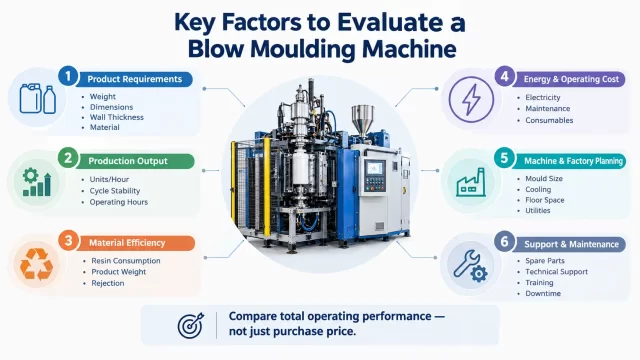
Choosing the best blow moulding machine in India requires more than finding the desired output. Product specification, material consumption, power use, cycle stability, maintenance, factory infrastructure and supplier support all need to align. Base the final decision on how reliably the machine performs after installation, not just its purchase price or rated output.
If you are planning a new production line, replacing existing equipment or increasing capacity, contact IFC Blow Moulding with your product and production requirements to discuss a suitable machine configuration.
Frequently Asked Questions
1. What should I check before buying a blow moulding machine?
Start with the product’s material, weight, dimensions, wall requirements and expected output. These factors help determine whether the best blow moulding machine in India suits your production requirements. Then assess capacity, mould compatibility, energy use, maintenance access and technical support.
2. How can a machine help reduce resin waste?
Consistent extrusion and controlled material distribution can help maintain product weight and wall thickness. This reduces the need for excess resin and can lower rejection caused by weak or inconsistent sections.
3. Is maximum output the most important specification?
No. Consider rated output alongside actual product requirements and cycle stability. A machine that consistently maintains the required production rate can be more valuable than equipment with higher theoretical capacity.
4. What should I consider for large containers?
Check extrusion capacity, clamping performance, mould dimensions, cooling, machine footprint and handling arrangements. Also confirm that factory utilities, lifting equipment and access routes can support the complete installation.
5. Why is energy efficiency important for blow moulding?
Energy is a recurring manufacturing expense. Lower consumption can reduce production costs and resource use over the machine’s working life, especially when equipment runs long shifts across multiple production days.
