Indian manufacturers producing jerry cans, lubricant containers, chemical packaging and industrial drums face a practical challenge. Orders can increase quickly, but simply pushing an existing machine harder does not always deliver more saleable products.
A production line must maintain the required container weight, dimensions and strength while operating for long hours. That makes machine selection a combination of production engineering, cost control and long-term capacity planning.
When Orders Test An HDPE Blow Moulding Machine Manufacturer India
Picture a plant that has recently secured a larger order for 20-litre HDPE lubricant containers. The existing machine can technically handle the product, but operators are already making frequent adjustments to keep output stable.
By the end of a long shift, small problems begin to add up. A mould takes longer to cool, a few containers fall outside the weight tolerance, and maintenance has to wait until the next available production window.
This is where the role of an HDPE blow moulding machine manufacturer India becomes more important than simply supplying equipment. The machine needs to be matched with the product, mould, material, and production target before it reaches the factory floor.
For plant owners, the useful figure is not maximum theoretical output. It is the number of acceptable containers the line can produce consistently during normal operation.
Making Every Production Cycle Count
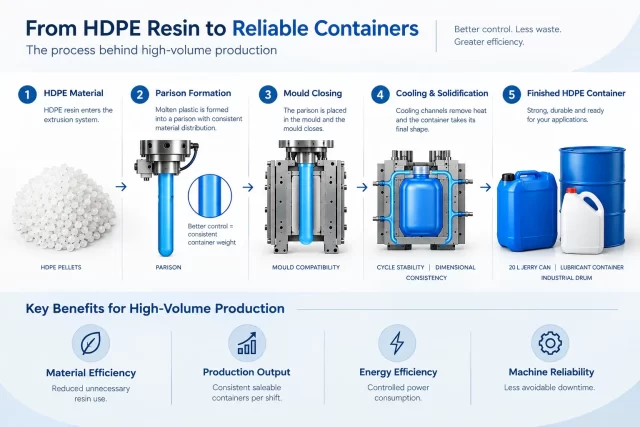
In extrusion blow moulding, the plastic parison forms the starting point for the container. Its size and distribution influence how much material remains in different areas of the finished product.
That becomes significant when production runs into thousands of units. If a container requires 450 grams of HDPE but the process regularly uses more than necessary, the difference accumulates across every shift.
For plastic blow moulding machine manufacturers in India, this makes process control an important part of machine design. an HDPE blow moulding machine manufacturer india should provide operators with suitable control over extrusion and moulding conditions rather than relying on constant manual correction.
A production team should examine:
- Parison consistency across repeated cycles
- Suitable extrusion capacity for the selected HDPE grade
- Cooling performance at the target cycle
- Mould compatibility and changeover requirements
- Ease of reaching components during servicing
- Control and monitoring functions
- Power consumption during regular operation
Better material control also supports manufacturing sustainability. Less excess plastic means lower resin consumption, while fewer rejects prevent the plant from spending material and energy on containers that cannot be dispatched.
How Extrusion Blow Moulding Machine Manufacturers Handle Mould Bottlenecks
A production manager may see a machine specification promising high output and assume the target is achievable. The mould can tell a different story.
Take a handled jerry can. Its handle, corners, and thicker sections do not cool in exactly the same way as the rest of the container. If cooling is not properly managed, the machine may need a longer cycle or the finished container may show dimensional variation after ejection.
This is one reason extrusion blow moulding machine manufacturers should be evaluated on the complete production system rather than extrusion capacity alone. An HDPE blow moulding machine manufacturer India should also demonstrate how its equipment manages the actual mould, cooling requirements, and target production rate.
The procurement team should ask what happens when the machine runs the actual mould at the required production rate. Application trials and technical discussions can reveal whether the proposed configuration can maintain product quality without slowing the line.
That distinction matters. A machine that produces a good container during a short demonstration but struggles after several hours of continuous production is not delivering its promised value.
What The Purchase Price Does Not Show
When blow moulding machine manufacturers submit competing quotations, the initial price is easy to compare. The operating cost is not.
A machine’s real financial impact appears over years of production through energy consumption, material usage, downtime, maintenance, and the number of saleable containers produced per shift.
|
Factor |
What procurement should examine |
| Practical output | Saleable containers produced during a normal shift |
| Material usage | Target container weight and process variation |
| Energy consumption | Power required during continuous production |
| Mould flexibility | Product range and changeover requirements |
| Maintenance | Service access and routine maintenance needs |
| Controls | Ease of monitoring production parameters |
| Technical support | Installation, commissioning and service assistance |
| Equipment life | Expected reliability over prolonged operation |
For HDPE containers, procurement teams should verify applicable BIS requirements for both the container specification and the polythene material used in production, based on the product’s capacity and intended application.
Suppose two machines have similar purchase prices. One consumes less material per container but requires more frequent maintenance. The other uses slightly more energy but runs reliably with fewer interruptions.
Neither is automatically the better investment. The plant needs to calculate the cost against its own production pattern. An HDPE blow moulding machine manufacturer India should be able to discuss these operating factors alongside the initial equipment cost.
Expanding Capacity Without Creating Another Problem
Capacity expansion often starts with a simple question: Do we need another machine? The answer may depend on what is actually limiting production.
If the existing line loses several hours each month because of maintenance, improving reliability could recover useful capacity without immediately adding another production unit. If demand has increased permanently, a higher-capacity machine may make more sense.
An HDPE blow moulding machine manufacturer India can help a plant evaluate these options against its product mix and expected demand.
Before approving new equipment, production and procurement teams should calculate:
- Current saleable output per shift
- Average cycle time for each major product
- Current reject and material-loss levels
- Planned production volume over the next few years
- Available floor space, power, and operator capacity
- Expected maintenance requirements and downtime
This gives management a clearer picture of what the new equipment actually needs to accomplish.
It also prevents a common problem: buying capacity that looks impressive on paper but remains underused because another part of the production system cannot keep up.
Reliability Matters After The Installation
The first few weeks with new equipment usually receive plenty of attention. The more revealing period comes months later, when the machine has become part of the daily production routine.
For a blow moulding machine in India, maintenance access, component durability, and technical support can influence how quickly a plant responds when something needs attention. This is an important consideration when selecting an HDPE blow moulding machine manufacturer India, particularly for multi-shift production.
Consider a three-shift operation where a small mechanical issue appears during the night shift. If the affected component is difficult to access or specialist assistance is unavailable, the cost is not limited to the repair itself. Production planning, dispatch schedules and labour utilisation can all be affected.
Preventive maintenance helps reduce that exposure. Easy access to service points also allows maintenance teams to complete routine work without unnecessarily extending production stoppages.
Long equipment life has another advantage. A machine that remains productive for many years makes better use of the resources invested in manufacturing, transporting, and installing it.
Efficiency Has A Direct Business Value
Sustainability becomes more practical when it is connected to production numbers. For manufacturers involved in blow moulding India, reducing material waste can lower purchasing costs at the same time as it reduces the amount of plastic entering the production cycle. Fewer rejected containers also mean less energy, labour and processing time spent on non-saleable products.
Energy efficiency matters in the same way. A difference in power consumption may appear small over one hour, but continuous production can turn that difference into a significant operating expense.
This is why plant managers should track more than output. Useful measures include material consumption per container, reject percentage, energy use, downtime, and maintenance frequency. These figures give an HDPE blow moulding machine manufacturer India a clearer basis for recommending equipment suited to the plant’s operating requirements.
Choosing The Best Blow Moulding Machine in India
The best blow moulding machine in India is not necessarily the one with the largest capacity. It is the machine that fits the container, production schedule, and operating conditions of the plant.
A manufacturer producing one high-volume jerry can may prioritise cycle stability and output. Another supplying several container sizes may place greater value on mould flexibility and changeover time.
The same principle applies when comparing a PET Bottle Blowing Machine Manufacturer with an HDPE blow moulding supplier. PET bottle production uses a different process and equipment configuration, so the supplier should be assessed according to the product being manufactured.
For procurement teams, the better starting point is therefore the container specification and annual production requirement. Once those are clear, machine capacity, controls, mould compatibility, energy use and maintenance requirements can be assessed against a measurable business case. The right HDPE blow moulding machine manufacturer India should be able to align its equipment with those requirements.
Conclusion
High-volume HDPE container production is a balancing act between output, consistency, material use, energy consumption, and machine reliability. A well-matched HDPE blow moulding machine manufacturer India can help manufacturers maintain stable cycles, reduce avoidable waste, and build production capacity without losing control of operating costs.
Contact IFC Blow Moulding to discuss your container design, required output, and production conditions. The right machine configuration should be based on what your plant needs to produce reliably, shift after shift.
Frequently Asked Questions
1. How does parison control affect HDPE container production?
Parison control influences how plastic is distributed throughout the container. Consistent distribution helps manufacturers maintain target weight, avoid unnecessarily thick areas, and reduce rejects while preserving the strength required for the finished product.
2. What should manufacturers consider when buying a blow moulding machine?
Manufacturers should consider practical output, container design, HDPE grade, cycle time, mould compatibility, energy consumption, maintenance access, and technical support. An HDPE blow moulding machine manufacturer India should match the equipment to the plant’s actual production requirements rather than maximum catalogue output.
3. Can better machine control reduce material wastage?
Yes. Stable extrusion and controlled parison formation can reduce excessive material distribution and process variation. Lower reject rates also reduce wasted resin, labour and energy, making material efficiency both an environmental and commercial consideration.
4. How does machine reliability affect high-volume production?
Frequent stoppages can reduce saleable output and disrupt production planning, packing and dispatch. An HDPE blow moulding machine manufacturer India can help address these risks through reliable components, preventive maintenance support and accessible service points for continuous, multi-shift manufacturing.
5. Is a higher-capacity blow moulding machine always better?
Not necessarily. An HDPE blow moulding machine manufacturer India should recommend capacity based on the plant’s actual production needs. A higher-capacity machine is useful only when suitable moulds, cooling, material supply, operators and downstream processes can support its production rate.
