
For plants evaluating 200 litre blow moulding machines India, material consumption is only one part of the decision. The equipment must also maintain consistent extrusion, support stable moulding cycles and produce containers that meet the required dimensions and strength.
This matters across Indian industries that use large plastic containers for chemicals, lubricants, agriculture, water treatment, and industrial storage. At this scale, a minor production variation can quickly become a recurring quality issue, material loss, or an expensive bottleneck.
Why 200L Production Needs Closer Control
A large container leaves less room for process variation. Small changes in parison distribution can create noticeable differences in wall thickness, finished weight, or container shape. Weight alone does not tell the whole story. A drum can meet its target weight while carrying excess material in one area and insufficient thickness in another.
The machine can offer value when its configuration matches the product being manufactured. Ensuring the target is controlled container weight, not just minimum weight, reassures the audience that you meet quality and efficiency standards.
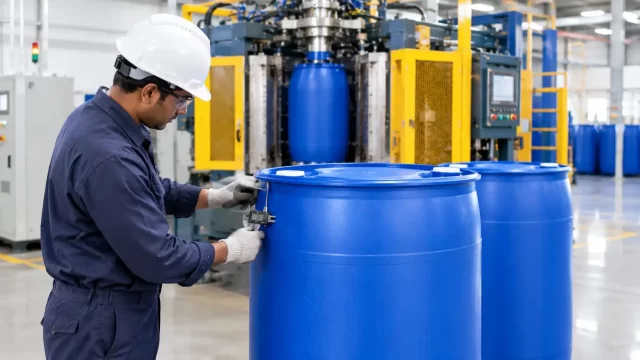
Turning Material Control Into Savings
Material optimisation means achieving the required container performance without carrying unnecessary plastic through every production cycle. With 200 litre blow moulding machines India, manufacturers can monitor container weight and wall distribution rather than simply chasing faster cycles.
A practical plant review can look at:
- Average container weight against the approved product specification.
- Weight variation between containers from the same production run.
- Rejects linked to thin sections, deformation, or dimensional variation.
- Material lost during start-up, trimming, and process adjustments.
- Reprocessed material generated during normal production.
Consider a plant producing 2,000 drums per day with just 100 grams of unnecessary plastic in each unit. That adds 200 kilograms of material consumption every day, before accounting for other process waste.
Material control should therefore be part of the machine decision from the beginning, helping reduce raw-material expenditure and avoidable plastic waste.
Where Machine Stability Protects Throughput
A production engineer does not usually judge a machine by its maximum speed alone. What matters on the factory floor is how consistently it delivers good containers throughout the shift. Reliable output makes production planning easier and gives the team greater confidence in meeting daily targets.
For 200 litre blow moulding machines India, repeated process adjustments during a long run can reduce effective output and make production planning less predictable, even when each interruption lasts only a few minutes.
Cooling can become another bottleneck. A large moulded container retains substantial heat, and uneven cooling can affect its shape after ejection or extend the next cycle. This can increase inspection requirements or cause dimensional failures.
Choosing Equipment Beyond The Quotation
When comparing plastic blow moulding machine manufacturers in India, procurement teams should assess expected production performance rather than focusing on the initial quotation alone.
A procurement manager should examine what happens after the purchase order is signed. Reliable installation, training, spare-parts availability, and service response can build confidence in ongoing support and ease concerns about operational continuity.
Experienced blow moulding machine manufacturers should also be able to explain how the proposed configuration addresses the container’s specifications, production targets, and maintenance requirements.
|
What procurement should assess |
Why it matters on the plant floor |
| Parison control | Helps manage material distribution and product consistency |
| Cooling capability | Supports dimensional stability in large containers |
| Control system | Makes repeatable process settings easier to maintain |
| Mould movement | Influences cycle reliability and operating consistency |
| Maintenance access | Can make routine servicing faster and more practical |
| Service support | Helps reduce the impact of technical problems |
| Spare-parts availability | Can prevent extended downtime during repairs |
Ask: “How many saleable containers should we expect during a normal shift after routine adjustments, planned maintenance and rejects?” This provides a more realistic basis for comparing machines.
Instead of asking only whether the machine can produce a 200-litre container, buyers can assess the finished product, cycle behaviour and operator experience under realistic conditions.
Matching Extrusion To The Actual Drum
Different extrusion blow moulding machine manufacturers offer different machine configurations, so buyers should assess the equipment against the actual geometry, weight and production requirements of their container.
For 200 litre blow moulding machines India, the parison needs suitable material distribution before the mould closes. On a large drum, poor distribution can leave excess plastic in some areas while reducing thickness around corners, handles, the base, and other mechanically important sections.
Production trials help engineers examine the actual container and identify where material accumulates or becomes too thin. This is also where engineers must consider mould design, processing conditions, and machine capability together.
For example, if quality checks show that drum weights remain within tolerance but failures occur around the base or handle area, increasing overall material weight may not solve the problem. Engineers need to investigate where that material is actually being distributed.
Energy Efficiency Starts With The Process
For 200 litre blow moulding machines India, rated power alone does not show production efficiency. Buyers should also consider the energy used to produce each saleable container, since rejected products and unnecessary stoppages still consume electricity without generating usable output.
Reducing stoppages, maintaining equipment, and keeping process conditions stable can improve resource efficiency. Preventive maintenance can also identify worn components before they contribute to poor performance or unplanned shutdowns.
The sustainability benefit is practical, not theoretical. Less rejected material means less plastic enters the waste stream. It also avoids spending electricity, machine time and labour on containers that never reach the customer.
Manufacturers can also refer to the Plastic Waste Management Rules for applicable requirements related to plastic waste management.
Matching Capacity To Production Demand
Machine capacity should match the factory’s product mix and expected demand. 100 litre blow moulding machines may suit smaller industrial packaging requirements, while 500 litre blow moulding machines are more relevant to bulk-storage applications. The 200-litre range can suit plants positioned between these requirements.
Before deciding, plant managers should compare:
- Current demand and realistic growth projections.
- Required container dimensions and finished weight.
- Number of shifts planned each day.
- Factory space, power and supporting utilities.
- Mould requirements across the product range.
- Expected maintenance and service arrangements.
A plant expecting demand to double within two years should check whether the selected machine can support that growth without creating another bottleneck. This depends on cycle performance, shifts, mould availability, and supporting utilities.
Where Machine Value Shows Up
The best blow moulding machine in India is not determined by capacity or purchase price alone. For 200 litre blow moulding machines India, the right choice is a machine that delivers the required number of saleable containers at the required quality and operating cost.
For an HDPE drum producer, stable extrusion and repeatable container formation may matter more than features with little effect on the finished product. Another manufacturer may prioritise mould flexibility or rapid changeovers.
When choosing an HDPE blow moulding machine manufacturer, buyers should assess its HDPE processing expertise, commissioning, maintenance and after-sales support. Technical assistance and replacement components can also affect long-term machine performance.
For manufacturers expanding Blow Moulding India operations, the machine should deliver consistent output, controlled material use, dependable quality, and room for realistic growth.
Check These Points Before Ordering
Before approving a blow moulding machine in India, decision-makers should connect each major specification with a measurable production requirement. The supplier should relate the proposed configuration to the actual container, material, production volume, and operating conditions.
Ask for evidence or clarification on:
- Container trials: Can the proposed configuration produce the actual container at the required weight and dimensions?
- Material distribution: How will wall-thickness consistency be assessed rather than relying on finished weight alone?
- Output: What good-container output can realistically be expected during a normal production shift?
- Maintenance: Which components need routine servicing, and how easily can operators access them?
- Support: What assistance is available during installation, commissioning, and future servicing?
- Future capacity: Can the machine support realistic changes in product mix or production volume?
These answers give procurement teams measurable criteria for comparing machines and suppliers: saleable output, reject levels, material consumption, downtime and operating cost.
Making The Right Production Choice
Large-container production depends more on consistent saleable output than headline machine speed. For manufacturers using 200 litre blow moulding machines India, the gains come from controlled material distribution, reliable cooling, fewer rejects, manageable maintenance and predictable output. The right configuration can also reduce material waste, improve energy use and support more sustainable manufacturing.
Contact IFC Blow Moulding to discuss your 200-litre container requirements, production target and material specifications, and identify a machine configuration suited to your plant.
Frequently Asked Questions
Why are 200-litre containers harder to produce consistently?
Their larger size makes variations in extrusion, cooling and moulding more noticeable. For 200 litre blow moulding machines India, uneven material distribution can affect wall thickness, weight and shape, making process stability particularly important during long production runs.
Can 200 litre blow moulding machines India help reduce plastic waste?
Yes. Consistent extrusion and moulding can help manufacturers maintain the required container weight without adding unnecessary material. Monitoring weight variation and reject rates can then identify where further material savings are possible.
Should machine speed be the main procurement criterion?
No. For 200 litre blow moulding machines India, production managers should consider good containers produced per shift, not maximum advertised speed alone. A fast machine that creates frequent rejects, adjustments, or stoppages may deliver less useful output than a slower, stable production cycle.
Why are production trials useful before purchasing?
Trials allow manufacturers to evaluate the actual container rather than relying only on specifications. They can check weight, dimensions, material distribution, cooling behaviour, cycle consistency and operator handling before committing to the equipment.
