
Whether a business produces lubricant bottles, chemical drums, pharmaceutical containers or FMCG packaging, customers expect every product to match the previous one. Repeated process variation across multiple production batches can increase material consumption, require additional quality checks and disrupt production schedules, ultimately increasing manufacturing costs.
Manufacturers adopting smarter production systems benefit from advanced machine controls that ensure stable processing conditions, helping maintain consistent quality throughout long production cycles and keeping production efficient.
Consistency Starts Before Plastic Takes Shape
Many manufacturers believe product quality depends mainly on the mould. In reality, consistency starts much earlier, before molten plastic even reaches the mould cavity. The way material flows, heats and forms determines whether every cycle produces identical results. This is where extrusion blow moulding machines make a measurable difference.
During a weekend production run before peak distribution season, an Indian lubricant manufacturer switched from 1-litre engine oil bottles to 5-litre containers for a fleet customer. The production team noticed bottle weights beginning to drift as the line settled after the mould change. Instead of relying on repeated manual corrections, advanced process controls stabilised melt flow and parison formation within a short period. As a result, filling accuracy remained consistent, cap fit stayed reliable, and the line reached full production with significantly less start-up scrap.
Advanced systems maintain stable processing conditions, helping manufacturers build long-term trust and confidence through consistent quality and reliability.
Building Stability Into Every Production Run
Manufacturers operating in competitive markets cannot rely on speed alone. They also need repeatability, especially when supplying customers who expect identical packaging every time. Advanced production systems are increasingly chosen by facilities that prioritise dependable manufacturing over occasional peak performance.
Across extrusion blow moulding machines India facilities, manufacturers are modernising production with technology that reduces process variation while supporting larger production volumes. Instead of stopping the line for constant corrections, operators can monitor key process conditions and respond before quality begins to decline.
Behind every consistent bottle is a series of controlled manufacturing actions rather than a single machine feature. Modern systems improve repeatability by managing several critical stages simultaneously:
- Stable melt temperature throughout extended production runs.
- Better parison control for consistent wall thickness.
- Reduced dependence on frequent manual machine adjustments.
- Faster recovery after planned product changeovers.
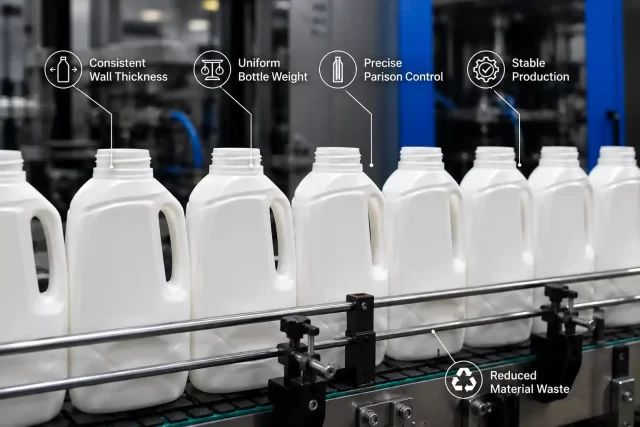
Each of these improvements works together. A stable melt temperature keeps polymer behaviour predictable, while precise parison programming distributes material where the finished container needs it most. The result is a more consistent bottle weight, stronger wall thickness, and fewer rejected products during extended production runs.
These improvements reduce waste and enhance production stability, giving manufacturers greater confidence in fulfilling large customer orders with strict quality standards.
The Hidden Cost of Inconsistent Production
While output figures are common metrics, experienced managers prioritise process stability because producing fewer defective units with consistent quality offers greater long-term manufacturing value.
The following comparison highlights why consistent production creates long-term manufacturing value when using extrusion blow moulding machines.
|
Manufacturing Challenge |
Advanced Machine Capability | Production Benefit |
|
Bottle weight variation |
Stable die-head pressure | Lower resin consumption and consistent bottle weight |
| Uneven wall thickness | Precise parison programming |
Stronger containers with improved dimensional consistency |
|
Frequent mould changeovers |
Faster process stabilisation | Reduced start-up scrap and quicker production recovery |
| Process drift during long production runs | Automated monitoring and real-time process control |
Consistent batch quality with fewer manual adjustments |
| Cooling inconsistencies | Balanced mould cooling |
Reduced shrinkage, warping and product rejection |
Looking beyond production numbers allows manufacturers to identify hidden costs that often go unnoticed until customer complaints or material losses surface.
Designing Machines for Repeatability
Leading blow moulding machine manufacturers in India understand that machine design influences far more than production capacity. Every component must contribute to process stability, because even minor mechanical inconsistencies can create noticeable differences in finished products. Modern extrusion blow moulding machines in India therefore focus on maintaining repeatability during continuous operation rather than simply achieving faster cycle times.
Consider a contract manufacturer that supplies packaging to both personal care brands and industrial chemical companies. Production may begin with cosmetic bottles in the morning, then switch to larger chemical containers later in the day. Every mould change introduces opportunities for bottle weight variation and dimensional inconsistency. Advanced machines shorten stabilisation time after each changeover, allowing manufacturers to achieve production-ready quality much faster while keeping scrap under control.
Rather than relying on repeated operator adjustments, advanced systems enable smoother production by enhancing process control and consistency. These include:
- Precise synchronisation between extrusion and mould closing for repeatable production cycles.
- Stable die-head pressure that keeps bottle weight consistent across long production runs.
- Balanced cooling that reduces shrinkage and dimensional variation after ejection.
- Automated monitoring that identifies process drift before product quality is affected.
This approach helps manufacturers deliver products that meet customer specifications while improving production confidence over the long term.
Why Visual Inspection Isn’t Enough
Customers usually notice colour, finish and overall appearance first. Manufacturers, however, understand that product consistency affects far more than visual quality. A container that looks identical but has uneven wall thickness may fail during transport, stacking or filling. This hidden variation often becomes expensive after products leave the factory.
An agrochemical manufacturer preparing inventory before the monsoon season may produce thousands of large containers every shift. If wall thickness varies between batches, the containers might perform well on the production line but fail during pallet stacking or long-distance transport. By maintaining consistent material distribution throughout every cycle, extrusion blow moulding machines help reduce these risks before products reach customers.
The strongest manufacturing operations are built on predictable processes rather than constant corrections. When every production cycle follows the same controlled path, manufacturers spend less time solving quality issues and more time improving productivity.
One of the biggest misconceptions in manufacturing is that quality is created during inspection. In reality, inspection only identifies defects after material, time, and energy have already been consumed. The most efficient factories focus on preventing variation before the mould closes, making process stability the first step towards consistent product quality.
Process Stability Shapes Long-Term Performance
Manufacturers are no longer choosing equipment based only on production capacity. Today, they also evaluate how well a machine performs after months of continuous operation, frequent product changes and varying production schedules. That is why plastic blow moulding machine manufacturers in India are placing greater emphasis on long-term process stability rather than headline production speeds. Under these demanding conditions, extrusion blow moulding machines continue to deliver repeatable output by maintaining critical production parameters within control.
A pharmaceutical packaging supplier may receive urgent orders for different bottle sizes within the same production shift. Switching from a 100 ml medicine bottle to a larger disinfectant container demands more than simply changing the mould. Advanced machines help stabilise extrusion parameters quickly, allowing production teams to return to specification with fewer trial runs and less material waste.
For manufacturers serving regulated industries, consistent production protects more than efficiency. It strengthens customer confidence, supports reliable delivery schedules and helps maintain the reputation that businesses spend years building.
Why Minor Process Drift Becomes Major Waste
Quality issues rarely begin with a major machine failure. More often, they develop through small variations that go unnoticed until waste starts to increase or customers report inconsistent products. Using extrusion blow moulding machines with advanced monitoring capabilities allows manufacturers to identify these changes before they affect overall production performance.
During festive demand, detergent manufacturers often increase production around the clock to keep distribution centres stocked. Even a small increase of a few grams in every bottle can consume several additional tonnes of resin over a large production batch. Advanced monitoring systems detect these trends early, allowing corrective action before material costs rise or customer specifications are affected.
Forward-thinking manufacturers therefore measure success by process consistency instead of maximum hourly output. Stable production reduces unexpected downtime, improves planning accuracy and supports sustainable manufacturing without sacrificing product quality.
Tomorrow’s Production Lines Need More Than Automation
Today’s manufacturers are expected to produce lighter packaging, reduce resin consumption and respond quickly to changing customer requirements without compromising quality. Advanced Extrusion Blow Moulding Machines support these goals by combining intelligent automation with consistent process control, enabling factories to improve productivity while preparing for future manufacturing demands.
Instead of viewing automation as a replacement for skilled operators, modern manufacturers use technology to enhance decision-making and reduce unnecessary variation. Intelligent controls provide better visibility into the production process, allowing teams to focus on optimisation rather than repeatedly correcting avoidable issues.
Many advanced production lines also integrate machine data with factory monitoring systems, allowing production managers to track performance trends, identify process drift early and make informed decisions using real-time production insights. This visibility helps maintain stable production across multiple shifts while supporting continuous process improvement.
As Best blow moulding machine in India solutions continue to advance, manufacturers gain advantages that extend beyond the factory floor. Better consistency improves customer satisfaction, reduces material waste, and strengthens production planning, making businesses more competitive in both domestic and international markets.
Manufacturers should ensure that extrusion blow moulding equipment is installed, operated and maintained in accordance with applicable factory safety requirements, machine operating guidelines and relevant industrial regulations before commencing commercial production.
Conclusion
Consistent product quality is not achieved through final inspection alone. It begins with stable extrusion, controlled material flow and repeatable production cycles that minimise variation before defects occur. Manufacturers investing in advanced extrusion blow moulding machines gain more than reliable equipment; they build production processes that deliver consistent quality, reduce material waste, and strengthen customer confidence over the long term.
Whether you are expanding production capacity, improving packaging consistency or reducing rejection rates, choosing the right manufacturing partner makes a measurable difference. Contact IFC Blow Moulding to explore advanced blow moulding India solutions designed to support reliable, efficient and future-ready manufacturing operations.
Frequently Asked Questions
1. How do advanced extrusion blow moulding machines improve product consistency?
Advanced machines maintain stable processing conditions throughout production by controlling melt flow, parison formation and cooling. This reduces variation between products, lowers rejection rates and helps manufacturers achieve consistent quality during long production runs.
2. Why is wall thickness consistency important in blow moulding?
Uniform wall thickness improves product strength, weight distribution and durability. It also helps containers perform better during filling, transportation, and storage while reducing the risk of leakage, deformation, or unexpected product failure.
3. Which industries benefit the most from extrusion blow moulding technology?
Industries such as FMCG, pharmaceuticals, agrochemicals, lubricants, automotive, personal care and industrial chemicals benefit significantly because they require high-volume production with consistent dimensions, reliable performance and repeatable product quality.
4. How do modern machines reduce material wastage?
Parison programming adjusts the wall thickness of the molten plastic tube before the mould closes. By distributing material more precisely, manufacturers achieve better wall-thickness consistency, stronger containers, lower material waste, and more reliable product performance across long production runs.
5. What should manufacturers consider when choosing a blow moulding machine in India?
Manufacturers should evaluate production stability, machine reliability, energy efficiency, automation features, after-sales support, ease of maintenance, and long-term operating costs rather than focusing solely on production speed or initial purchase price.
6. Why is consistent production more valuable than maximum production speed?
A stable production process produces fewer defective products, reduces downtime and improves customer satisfaction. Over time, consistent quality lowers operating costs, strengthens business reputation and creates a more reliable manufacturing operation than simply increasing output.
