Most factories don’t notice the problem immediately. It usually begins with a slight variation. Operators start adjusting settings, and over time, output becomes inconsistent. A packaging unit switching between material grades often experiences this, where output remains high initially but becomes unstable after a few hours of operation.
Instead of designing machines for ideal conditions, manufacturers are now engineering systems that perform reliably under real production conditions, reducing the need for manual corrections.
How Important Is Consistency Over Speed in Production?
There was a time when production speed alone defined machine capability. That approach often resulted in uneven wall thickness, inconsistent neck finishing, and dimensional variation across long runs.
Today, the priority has shifted toward repeatable output. Machines must maintain consistent performance across every cycle, especially in packaging and chemical storage applications where uniformity directly affects product safety and usability.
On paper, higher speed looks good. On the shop floor, it often creates more problems than it solves. Output may appear high, but rejection increases due to weak areas or dimensional variation. Over time, this reduces usable production and increases resin consumption per unit.
As this transition continues, HDPE blow moulding machine manufacturers are redesigning systems to focus on controlled extrusion, stable mould operation, and synchronised cycle timing to ensure predictable production results.
What Happens When Material Starts Controlling the Process?
Material variability has become a significant challenge as the use of recycled HDPE and mixed-grade polymers has increased. Differences in melt flow and thermal behaviour can disrupt forming if not controlled precisely.
To manage this, manufacturers are improving extrusion stability and heat distribution so that processing remains consistent even with variable inputs, a requirement increasingly addressed by HDPE blow moulding machine manufacturers in India.
Modern machines now incorporate precision extrusion screws that regulate material flow more accurately, along with advanced parison programming that maintains uniform thickness across different product shapes. Zoned heating systems help stabilize melt conditions, while controlled cooling prevents deformation and shrinkage during forming.
When machines can’t handle this variation, operators usually compensate by adding more material. This unnecessarily increases product weight and raises resin cost per unit. These improvements directly reduce material wastage, improve product strength, and lower rejection rates.
Why Does Production No Longer Run One Product?
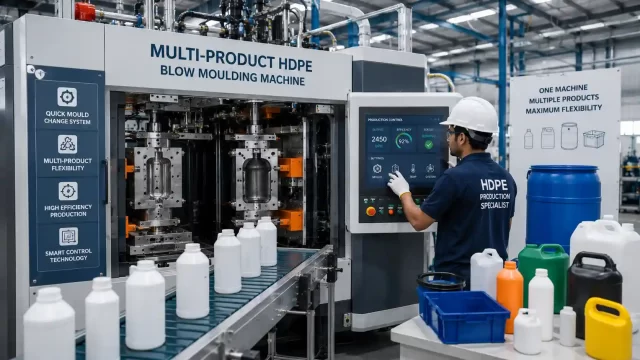
Production today is messy; one shift might run three different products. Machines have to adapt quickly. Otherwise, output drops or becomes inconsistent. This requires faster mould changeovers and automated adjustment of process parameters, such as temperature, pressure, and cycle timing.
|
Demand Shift |
Machine Requirement | Industry Response |
|
Product variation |
Flexible mould compatibility | Quick-change mould systems |
| Short production | Faster setup and transition |
Automated cycle adjustments |
|
Material diversity |
Stable processing | Advanced extrusion control |
| High quality | Uniform output |
Precision engineering |
| Cost pressure | Efficient operation |
Energy-saving systems |
In many production setups, changeovers become a hidden bottleneck. If machines require manual tuning for each product, valuable production time is lost between runs, reducing overall daily output.
To address this, HDPE blow moulding machine manufacturers in India are designing systems that store parameters and reduce reliance on manual setup, enabling faster transitions without compromising quality.
How Do Complex Machines Slow Production Down?
As machines become more advanced, operational complexity can slow down production if not managed properly. Systems that require constant monitoring or skilled intervention increase labour dependency and the risk of human error.
Manufacturers are simplifying control systems while strengthening internal performance. Operators can manage production efficiently with intuitive interfaces and preset programs, reducing setup time and improving consistency.
Key improvements include:
- Touch-based control panels with preset configurations
- Automated fault detection for faster troubleshooting
- Modular components that reduce maintenance time
- Durable construction for continuous production cycles
In many factories, output variation between shifts is often linked to operator handling rather than machine capability. Systems that depend heavily on manual adjustments tend to produce inconsistent results across different operators. This shift toward usability-focused design is becoming a defining factor, as it directly impacts productivity and training requirements.
Where Do Most Machines Start To Drift?
Small variations in heat balance or cycle timing slowly compound, leading to visible inconsistency across production runs. HDPE blow moulding machine manufacturers are increasingly prioritising stability in machine design, as even minor fluctuations in temperature, pressure, or timing can affect product quality over long production cycles. Modern systems are designed in line with relevant BIS guidelines and IEC 60204-1, ensuring safe electrical design and reliable operation during continuous production.
Machines must maintain consistent operating conditions without frequent recalibration. Stable extrusion, uniform cooling, and precise cycle control ensure that every product meets the required specifications. Stable machines waste less material. That’s the real benefit. It improves material utilisation and supports uninterrupted production.
Why Are Machines That Can’t Adapt Getting Replaced?
Modern production systems must adapt to changing requirements without compromising performance. Machines are expected to handle a range of product sizes, materials, and production volumes within the same setup. Automation, smarter control systems, and improved material handling are helping achieve this flexibility, a direction clearly seen among HDPE blow moulding machine manufacturers in India.
In growing businesses, product lines often expand faster than expected. Without adaptable machines, manufacturers are forced to invest in additional equipment or accept slower production cycles, both of which increase operational cost. These advancements allow manufacturers to respond quickly to market demands while maintaining efficiency, reducing downtime, and improving overall production output.
Where Does IFC Actually Make the Difference?
When production gets unpredictable, and it usually does, the machine you choose starts to matter more than expected.
In practical terms, this is where HDPE blow moulding machine manufacturers in India are judged, on how well their machines perform across real production conditions.
Key Machine Features That Improve Production
- High-precision extrusion blow moulding machine India for uniform material flow
- Advanced parison control for consistent wall thickness
- Energy-efficient heating for reduced power consumption
- Quick mould change capability for faster transitions
- Strong machine structure for stable long-term operation
- Smart controls with preset configurations
Why Manufacturers Choose IFC
- Consistent output across long production runs
- Reduced rejection and material wastage
- Faster changeovers for multi-product production
- Lower maintenance interruptions
- Better overall production efficiency
These advantages directly impact cost, output, and reliability, which is why HDPE blow moulding machine manufacturers are increasingly evaluated based on real performance rather than specifications alone.
What Actually Affects Your Daily Output?
Understanding trends is useful only if machines can deliver under real conditions. The key question for manufacturers is whether the system can handle daily production demands without instability. In real factory setups, HDPE blow moulding machine manufacturers in India are judged on how machines perform across product sizes, volumes, and continuous operating hours.
Small bottles may run in multi-cavity setups, where output depends on cycle consistency. Larger containers require precise wall thickness to prevent collapse during stacking. Drums require a balanced distribution of material to avoid deformation.
A machine producing high output with high rejection is less efficient than one delivering slightly lower output with stable quality. This is where consistent cycle control, stable extrusion, and uniform cooling become critical. Machines that maintain this balance help manufacturers improve usable output, reduce scrap, and stabilise production over time.
Conclusion
Choosing a machine isn’t just about specs anymore, it’s about how it performs after hours of continuous production. In real conditions, performance shows up in consistency, how well the system handles material variation, and how often operators need to step in.
Small inefficiencies like higher scrap, longer changeovers, unstable cycles, don’t stay small. They build into real operational losses over time. That’s why working with the right HDPE blow moulding machine manufacturers in India is a long-term decision, not a quick purchase.
If you’re planning to invest in equipment that delivers stable output and reliable performance, visit IFC Blow Moulding and explore solutions designed for real production conditions.
FAQs
- How are market trends influencing blow moulding machines?
Market trends are driving machines toward greater efficiency, adaptability, and consistent output, helping manufacturers meet evolving production requirements.
- Why is precision important in blow moulding India?
Precision ensures uniform product quality, reduces waste, and improves production efficiency, especially in high-volume applications.
- How do machines handle recycled materials?
Modern machines use controlled extrusion and stable heating systems to effectively manage material variability.
- What makes modern machines more efficient?
Automation, improved control systems, and energy-efficient designs increase machine performance and reduce operational cost.
- Why is flexibility important in production?
Flexibility allows machines to handle multiple product types and batch sizes without increasing downtime.
- How to choose the right blow moulding machine?
Choose based on consistency, efficiency, adaptability, and ease of maintenance to ensure long-term production performance.
